Showing posts with label try-out. Show all posts

Monday, 20 March 2017

One red top: modified!

I am so very pleased!  I altered a red top that I had for some years and I still love, love, love the colour, but the fit is much too tight over the bust and I got bored with the overall look.

My good friend Tash unwittingly gave me a great design idea.  She was going to use a scallop hem tutorial and this made me think about what other shapes you could do.

This top makes a great project to try out my shaped hem idea. If it works then great, but if it doesn't then I can either chop off the hem and straighten it back out, or just let this go.

It worked out well!

This is what I started with:


It was only when I looked that I realised that I already had to do a repair job on the top of the side seams.  I hadn't worn this in a while so I didn't recall that there were holes, - and my hand sewing wasn't all that great either:


I machine basted the hem to turn out and press (I pressed to the inside first but realised that this wouldn't work. Lucky escape!).  Then I drew the pattern on and started to v-e-r-y slowly stitch it. It wasn't as easy as I expected:


My shape is a bit overly complex.  But I like it a lot.

I then turned this inside out and prodded and poked until all the little corners and peaks looked okay.  Again not as easy as I blithely assumed:  my scissor tip method did end in a couple of frayed tread ends poking through.  I ruthlessly cut those off.  This isn't a high value item - I just want to enjoy it while it lasts.


Then I edge-stitched this to retain the shape when I wash this next time:

No idea why this is upside down

I also ripped the long sleeves out and inserts wedge shaped gussets into the top of the side seams. This way I could make the top big enough to fit at the bust, and it also had the added advantage of getting rid of those pesky holes. Win-win!

I scooped the armholes out a bit to make a pleasing shape.  That ended up being a bit of a problem: the armholes probably gaped before but this emphasises it.  So I sewed bust darts in, longer ones at first but these looked awful, then shorter ones.  I am still not over the moon with this area, but I think top is wearable.

Here it is:


I think this is a successful project that I hope to get lots of wear out of in the summer!

Thank you Tash for the inspiration!

Wednesday, 4 January 2017

New year, new project

I am incredibly pleased that I started to cut out my first project of the new year on the second day of the year.  That's an auspicious start of something I want to do a lot of: to sew and use up more of my fabrics.


I hadn't made up my mind yet about which size I was going to use, the largest might be something like XXXL (size 52).  For some reason I had left all the different sizes on the paper pieces but then didn't notice.  So I needed to change the sleeve curves that had come out a bit too 'curvy'.  It worked though.

The following day I cut out some more pieces and did a first few seams.

The pattern is one that I had to buy again because I cannot lay my hands on the tissue pattern, I have only the photo and instructions left in the envelope.  I checked in currently available patterns (as many as I could bear to look through) but I couldn't find a similar style: Burda 6230 is a very loose shirt, or what I call an 'over blouse' - a shirt you can wear over a heck of a lot because it is so over-sized.

What I like about it is that you piece together the front and the back: there is a horizontal seam line from the yoke that extends into the cut-on sleeves, and they have a diagonal seamline between the lower sleeve and the front/back so you don't have to use extra wide fabric.  See the black and white drawing on the pattern envelope shown above.

The yoke piece that extends into the sleeves ends near the cuffs in a sharp point. I thought that looked very clever.  Not so great for shortening the sleeves: I can't wear the oringal length sleeves, they're 10 cm too long!

My first 2017 project is a muslin of this pattern because I want to check that I shortened the sleeves correctly (that yoke piece needs to be sewn to the united front/back piece and the lower sleeve piece. I can't know if it's right until I've sewn that seam). And I also want to see what the length is like on me. It'll probably drown me!

But seeing how long this is as an actual garment is better for deciding how much I want to shorten it by once I use my actual fabric.  I want to use a white fabric with white machine stitching on it that I bought in a shop clearance sale just before Atlantic Silk in Electric Avenue, Brixton closed its doors for good. Shame, this was a good fabric shop, particularly the back area.  At least Simply Fabrics is still around.

I don't want to cut into this beautiful fabric and mess it up.  I have not seen another fabric like it in all the years in which I amassed my fabric stash - so I've seen a few.  It is pretty thin and looks quite crisp but I haven't washed it yet. It's just so much easier to sew with a fabric that still has that sizing layer on it and I reckon the pattern is loose enough that it can't shrink too much if it even does.

I still haven't decided if size 52 is right for me.  I didn't exactly chose to use that size because I blindly followed the outlines. Oh oops.

But I am sewing! And that's the main thing.  Very pleased.

PS: On the third day of sewing (4 January) I've assembled the front and the back and sewed them together at the shoulder/top of sleeve seams. The button bands are not attached on the inside yet but they are on the outside. I cut and interfaced the colour and will probably attach it next.

PS: I forgot that I blogged twice about this pattern, both in July 2016: That 'over blouse' pattern I've long been looking for and also: What did I do today?

Wednesday, 14 December 2016

WIP: Sleeveless tunic with clever pockets

This is one of the unfinished objects (UFOs) that I want to include in the virtual sewalong event of the Dressmakers (LDC) group: "UFO: Alter, chuck or finish?".

When I bought YET more fabric a couple of years back, like this one that looks like brushed cotton or similar to denim, I felt that I needed to use the fabric up as quickly as possible and went with what I thought would be easy.

Use my own measurements, copy the pattern pieces off my body block and go with straight princess line seams (going straight up into the shoulder so no convex curves need pinning against concave curves). A yoke for the back to avoid needing to sew over eight layers of fabric, and a side zip.

Unfortunately this did not turn into a quick project because it's STILL not finished. Yup. Bane of my life.

I think the ideas above are not bad - they definitely make sense. It's just that I ran into some problems that I had not anticipated.


1) It is too big: the pins above show where I want to take in the princess seams so I can get at least the impression of a waist. My body block does not have much of a waist and that acts like a sack pulled over my body: it makes it appear even more dumpy than it is. Definitely needing improvement.

There  are quite a few layers of fabric, thanks to the pocket construction.  I don't feel very confident at doing a good job when I finally do take these seams in.


2) I already put the side zip in and quite well too, thanks very much, so I am really loathe to have to unpick it. Particularly as I managed to sew over the pocket layers.  Can I get away with just tightening up the princess seams or do the side seams also need cinching in?  How the heck would I then get the zip back in?


3) The pockets: I am so proud of their construction. The fabric layer that comes down from the shoulder then disapears into the pockets and becomes the inner pocket. The added piece that is the outside of the pocket will then go down to the hem.  Which means that the patterned FQ that's the pocket lining and that first fabric layer (the one running down from the shoulder) do not need to be as long as the hem. I just don't know yet how deep I want my pockets to be so I have not cut the bottom edge of both fabrics. That'll be easy.

The blue side is the right side of the fabric, the black side is the wrong side of the fabric.


4) Unfortunately I the pieces too much for the skirt part - I made these much too wide at the hem. I did not expect the fabric stiffness to turn the middle panel into the shape of a sky jump, from the bust downward: there is no dip - it looks awful. It emphasises my stomach too, horrible. This is actually the worst problem with this garment.

I have to take the flare down a lot. Unfortunately I don't know by how much and I feel anxious about messing up at this point.


5) I made a mess of the back yoke. The back neckline gapes so I just put some darts in and not at all well. I will have to unpick them. I only realised since this project that I have a rounded upper back and need small darts at the back mid shoulder point that will take the fullness out. Unless I try a dart at the centre back?  I'm not sure that this would work though.

6) I don't have a photo of the small of the back but I got that wrong too: I thought I could introduce a swayback adjustment by manipulating the shape of the middle panel of the back. And pinching a wedge out of the side panels before cutting them out. I may not have done enough of that because it hasn't worked.

I wonder if I have enough fabric left to try just the back again?  I may have to research swayback adjustments a lot more because I have the distinct feeling that I don't know enough about them yet to get them right.


So there you have it.

I put a few good ideas into this self-drafted pattern. I ran into some problems where my body block isn't good enough: namely at the waist and also regarding my swayback and my rounded upper back (my body block pattern actually has the darts drawn in - silly me decided to ignore them. Ahem).

I also ran into some problems that confounded me: how can this little bit of flare be too much?  And how do I get rid of it?

I think I would have carried on with this tunic sooner if there had been only a couple of problems. That many really put me off. The most decisive problem though is that I don't think I'll enjoy wearing this even if I do get it done.

On the other hand this tunic is a good practice piece to figure out these kinds of issues so I can use whatever I learn for future projects - I just didn't expect one single project where I get to learn quite so much!  It just all feels a bit too intense.

On the other hand and being brutally honest with myself, I might not have carried on even with just a single issue: I often grind to a halt and find it very difficult to motivate myself into picking it back up.  If I want to wear it then things are a lot easier - but if I don't feel the project, or can't visualise myself in it, then I have a huge sewing mojo problem.

Oh heck.

Trying to make up my mind about "Alter, chuck or finish?", I find myself in the "Finish" camp: I would really learn a lot and I want to see the pocket construction realised in a complete project. Even if I then give the whole thing away to a charity shop - if I don't wear it. Who knows.

I ought to decide which of the above issues I feel like tackling first - that would go a long way towards getting back into the swing of things on this project.

Thursday, 8 December 2016

Simplicity 8523 changed to bias cut

This was a very interesting learning exercise: you can change a simple top from a straight fabric grain line (as intended by the pattern company) to one cut out on the bias.

It actually works!

I happened to come across an intriguing YouTube video (by Kair Bjordahl at National Sewing Circle) that discussed this, and even suggested Simplicity 8523 as an example. Which reminded me that I own this pattern and could go and have a look.

I did, I found it, and I had a go!  Nothing better than taking advantage of the sudden urge to sew. You have to go with the momentum of your sewing mojo. It would be criminal not to.


I did a full bust adjustment so it's interesting that the bias cut fabric does drag a bit at the bust. I reckon I used the wrong fabric: a polycotton that's a bit thicker than the usual thin polycottons.  I also didn't prewash the fabric so I have yet to see how the top looks after the first wash.

There is also a whole lot of bunching going on at the front of the upper arms: there are drag lines towards the apex. I often get this with pretty much everything I wear: whether shop bought or made myself. I have a feeling that I need a second dart.

I also want to see what difference another type of fabric makes.


I often have problems sewing the sleeves in. I managed a bit of puckering on the sleeve on the right.

Modern fabrics are not truly evenly woven so warp and weft behave slightly differently.  That's the reason why a bias-cut garment will not hang and drape completely symetrically. You can see this in the photo above.

Because of this bias-cut patterns often suggest a centre front and back seam, but you use up lots more fabric that way because the two pieces need to be laid so they form a V or chevron shape. That produces lots of fabric remnants in awkward shapes. You might be able to use them in applique or for patchwork.

I may also have cut the sleeve from the lower fabric layer at not quite the correct 45 degree angle. I have a feeling it may have shifted a bit. I really need to watch this more closely next time.  I lenghtened them by an inch to avoid that chicken wing look that I hate, but now realise that I could have gone with the original length.


I also had to adjust the point of the V-neck a little bit, it looked off by around 7-8 millimeter or so (just under a centimeter).  That was no problem because the pattern's V-neck was a little high and I wanted this to be lower.


The back doesn't look too bad but it is also slightly asymetrical.  I may want to cinch in the waist a touch more. I graded this out to a bigger size according to my measurements but think I overdid it a bit.

Oops, all bunched up

This was supposed to be a muslin to try this out and I will probably not wear it a lot because of the colour. I bought the fabric online with the intention of using it for patchwork but the colour is lots lighter than I expected.

This top is quite comfortbale despite the issues I described, so who knows.

I did not expect this pattern to fit me without adjustments but I had hoped it would be closer to a better fit. I knew that I might need a swayback adjustment but didn't want to bother at this stage.  It was an extremely useful learning exercise and I am pleased this fits as well as it does, even though that fit is not great.

Next time I want to use my own body block pattern to try another bias-cut top. In another fabric, hopefully something more drapey (it depends on my fabric stash: I have to use up what I've got as much as I can). And slightly shorter sleeves than these.

I will report my findings!


Monday, 5 December 2016

Delving into my sewing patterns: V1164

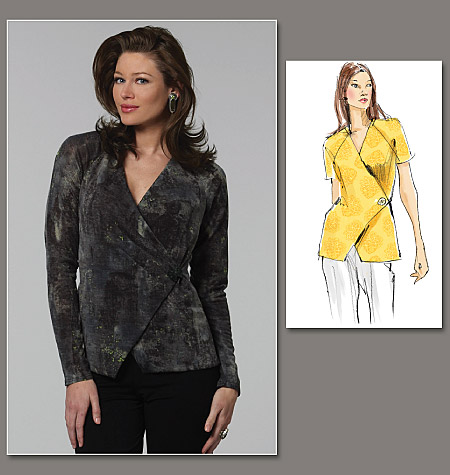
Following on from my previous post on my sewing pattern stash, I had the sudden urge to look at a Vogue pattern with interesting Dolman-style sleeves.  I am not at all convinced that these suit my figure but I wanted a look.

I didn't find it* and got a bit frustrated until I came across another pattern that I bought because it has raglan sleeves and wraps over at the front.  I thought this would make a great pattern to make up in all kinds of different fabrics.  Unfortunately I failed to see that this is for knit fabrics only.  Darn.  That's not what I was after at all.  I don't sew well with stretch fabrics.

V1164
This looks like it could be a really flattering style and I haven't made anything like this before. I won't find out what this will look like on me until I make it up and try it on.

For my muslin, I found a cheap pink stretch fabric left over from another project (that didn't turn out well, damn) and cut it out. And even sewed it up!  I am very pleased with that.

What I learnt from working with this fabric: there is absolutely no point for me to buy cheap and thin jersey fabrics: I hate working with them and they look saggy and cheap. And they don't wear well either because they wrinkle like mad.

I still have some fabrics that are almost as thin (in purple, grey and light pink) but I think they weren't as cheap and hopefully don't wrinkle as much. I'll have to check.  When I bought them I had visions of making long-sleeved T-shirt style tops as wardrobe staples. But if I don't enjoy working with them, nor like wearing them...

I should try those firmer knits instead. But then again I'd rather work with patterns for woven fabrics and erode my humungous stash of those. So there is no Ponte knit fabric shopping in my immediate future.

I did have to buy something for this project unfortunately: the front pieces of this need to be lined - to finish off the edges and to stablise them. I don't want to try a woven lining because I don't think it'll work and I had run out of stretch lining.  The pattern recommended stretch mesh or tricot. So I ordered a meter of light mesh. Who knows when I'll get that and if I'll still be in the mood for carrying on with this project.

The pink muslin showed that the style is promising: the V-neck looks good on me and I'll have to see how a slightly firmer fabric will behave in terms of fit around my middle and near the shoulders.

If I make this with short sleeves again I will want to lengthen the sleeves at the top by at least 1-1.5 inches.  I have enough fabric for long sleeves for the actual project. I just need that lining fabric first.

But even though I've run into this delay: it is really good to know that I made a start with a type of pattern I hadn't used before. That's exactly what I had in mind when I wrote the previous blog post

Brush strokes: mainly pink/purple and dark grey
Vogue 1164: View A in grey on the left has some darts near where the closure sits, View B in yellow doesn't. I tried the non-darted version in my cheap pink jersey fabric. The pattern of my project fabric would look a bit weird if darted so I will probably stick with View B (see 'Brush strokes' above).

Both views use the non-darted front pattern piece (2) for the lining.


*: I found the pattern since: it is V1239, Chado Ralph Rucci. This one:

V1239
I now think that this is also not suitable for me, because of the sleeves. Where they connect to the front and to the back is very odd: as far away from under the arm as may be possible to get. Very odd. Possibly an okay style for someone much less busty than me. So I will give this one a miss.
 
I would like to use this pattern to Frankenpattern the neckline part with another blouse pattern though (at least with rounded edges, not corners near the chin) - that line is beautiful.
 

Thursday, 8 January 2015

Fitting issues

I am puzzling out my fitting issues right now.  It was very frustrating that I would use the bodice block drawn to my own measurements, make relevant adjustments, and still not end up with a bodice that fits well!

I was beginning to doubt either my sanity or my ability to translate the fitting issues into adjustments that solve them.

I always have to take a wedge out at the top of the side seams, under the arms.  A wedge of a good centimetre across and over a length of about 7cm – from both front and back piece (as far as the width is concerned).  So I took out almost an inch from the armhole edge.  It seems a lot and I didn’t understand at all why I had to do that.

I recently realised why.  This is not an issue to do with sleeveless  versus with sleeves as such (sleeveless may need a tighter armhole than a top with sleeves does: you want to be able to move your arms when there are sleeves) – it has to do with my being low-busted.  That’s the opposite of the perky, petite shape of young women – the high and small busts that are very suited to the empire line dresses of Regency England.  My cup size is much bigger than that but most of all the bust point is at a completely different height: much lower down.


I kept noticing a pronounced bagginess of bought clothes at the front, right next to the vertical armhole seam, below the shoulder.  It took me a while to realise that if I take that excess and smooth it over to the armhole, I end up taking this out of the side seam – and guess by how much?  Oh yeah exactly: by that same wedge I describe above.  Oh!

Well that explains it then, doesn't it?
I did figure out that I often need to make the bust dart deeper, because of diagonal lines radiating out from the bust point.  I have done FBAs but was perhaps underestimating the width of the bust dart.  I need to check this out again.  I was really worried about the measure of the armhole though.  Wouldn’t a deeper bust dart make the  armhole too small?

I thought this over and just decided that this doesn't have to be a problem: why don’t I measure how much my armhole should be for dresses to be comfortable?  I can experiment with whether a sleeveless top is still comfortable with a smaller armhole, and whether a sleeved dress needs a bigger armhole.  I can also experiment with the shape.

That’s another fitting issue:  I would like to make a top that is looser in the sleeves and from there towards the centre of the body.  I won't be able to just make it very loose across the bust – surely I don’t want excessive amounts of material there?  That would make a top too baggy.  But below the bust:  I should be able to go for a blouse top that gets baggy and loose from the bust area down to past the waist (ending near the hip).  I just don’t want kimono sleeves (I already have a pattern that I made so often that I now desperately need a sewing challenge. It just doesn't fit nor look well enough).  I want set-in sleeves.

Which makes me worried about the shape of the armhole which should influence the shape of the sleevehead?  But how?


I am thinking that I’ll need to do quite a few variations of sleeves and armholes to figure that out in practice.  If I only do one and then evaluate, then try and start a second version, etc... that won't take me far and I’ll be too discouraged, - I’ll think that I won’t be able to solve this.  But if I do several at the same time so I can also compare them easily and equally (as opposed to serially) then it should be easier to make a judgment about what works.  I think.  When you make a series of versions you are inclined to try and see the later versions as better, but if they don't feel better it just leads to huge disappointment and energy-sapping discouragement.  I want to get away from that.

I also need to look into swayback adjustments and decide who they work for me and whether I need to lengthen the front piece a bit to account for my big tummy measurement.

That should do it for the major adjustments to achieve a better fit.

It did feel quite overwhelming but I think I can tackle these issues one by one.  There is no point in going squint-eyed over all the different issues when you can get mull over the one issue at hand, as long as I manage to focus.


Sunday, 28 July 2013

Trial quilt block

So much fabric, so little time.  I need to make inroads into my stash.

I keep pulling out fabrics to try and decide which other fabric they go with.  I decided I might as well indulge in my usual process: just get started and see where it leads me.  So much more organic, isn't it!

Oh okay, I admit it: I suffer from startitis and an inability to finish (most) things.  But if I try something out then I know if I'll like it, and if I want to carry on with it? Don't I.  But if I don't give something a trial run, then I won't know.

So I pulled out these three fabrics, all from the same range (darned if I remember which one, or where I got it from) - so at least I can be assured that they do indeed go with each other.  Great.

I've been obsessive in looking at quilt block patterns recently.  I couldn't stop!

I found one that I very much like, so I gave that a go.  Here it is:


One block made up of four of these units, with some sashing in the same black fabric.  I find the layout very pleasing and love the way it looks.

But do you know?  I didn't actually enjoy making this particular block pattern.  I'm not sure quite sure why that is.  I just couldn't get the points to come out at a quarter inch from the edges. 

The outside edges of this will unfortunately have to be sewn very skinny.  It ran into that problem from the very start.  I did okay with the first side-by-side triangle units, the navy and black fabric.  But they came out smaller than I wanted (I keep doing that), so I cut the light blue fabric rhomboids very generously to make sure that I wouldn't run into problems there as well.

I had to trim them down a lot, but the navy/black triangles were a right pain to sew onto the second side of the rhomboids: they ended up in the wrong place horizontally.  I had to rip and re-do so many times that I lost all patience. 

I am definitely not going to sew this one again.  This block will remain a one-off!  So there.

If I ever make a big quilt with this block, it will have to be a sampler type quilt with all sorts of different blocks.  I think that I might combine these three colours with grey and also a couple of suitable pinks.

But I am still pretty annoyed with how difficult this was to put together.  It was probably not a good idea to do pretty skinny seams because they must have made the problem worse with each new seam.

Next time I need to make a template to measure the completed units against.  Or do this paper pieced and not the traditional assembly way.  That might save me a whole lot of cursing.


x - x - x

There was one good thing about sewing this block: I figured out how to cut the squares the easiest way.

Initially I cut the assembly-line pieced squares through the centre of the two seams, like you would do for half square triangles (HSTs) before cutting the other way.  Doing that unfortunately makes it necessary to lay the triangle just so, so you can cut into two equal pieces: you can't aim for the other corner because that side is obviously already been cut away.  Duh.

Lots of faffing around.  Too annoying for words.

Instead I first cut the diagonal without the seams.  I hope the two seams (horizontal orientation) aren't too difficult to see:


It is then much easier to just slice through the centre of the parallel seams - no faffing around needed.  I will remember that next time!